Closing the Loop on Card Returns: Reducing Loss Through Smarter Transaction Matching
Returns are a normal part of any card payment experience. But behind the scenes, linking a return to its original purchase is not always straightforward.
Transaction identifiers may not match, placeholder values may be used, and data can arrive inconsistently across payment networks. These variations make it difficult to reliably determine which original transaction a return belongs to.
When a return cannot be correctly matched, the impact goes beyond reconciliation. Rewards may be credited more than once, reversals may go unnoticed, and the original transaction may remain active even after a refund has been processed. Each individual case may seem small, but at scale, these gaps can lead to significant financial leakage.
Closing the Matching Gap
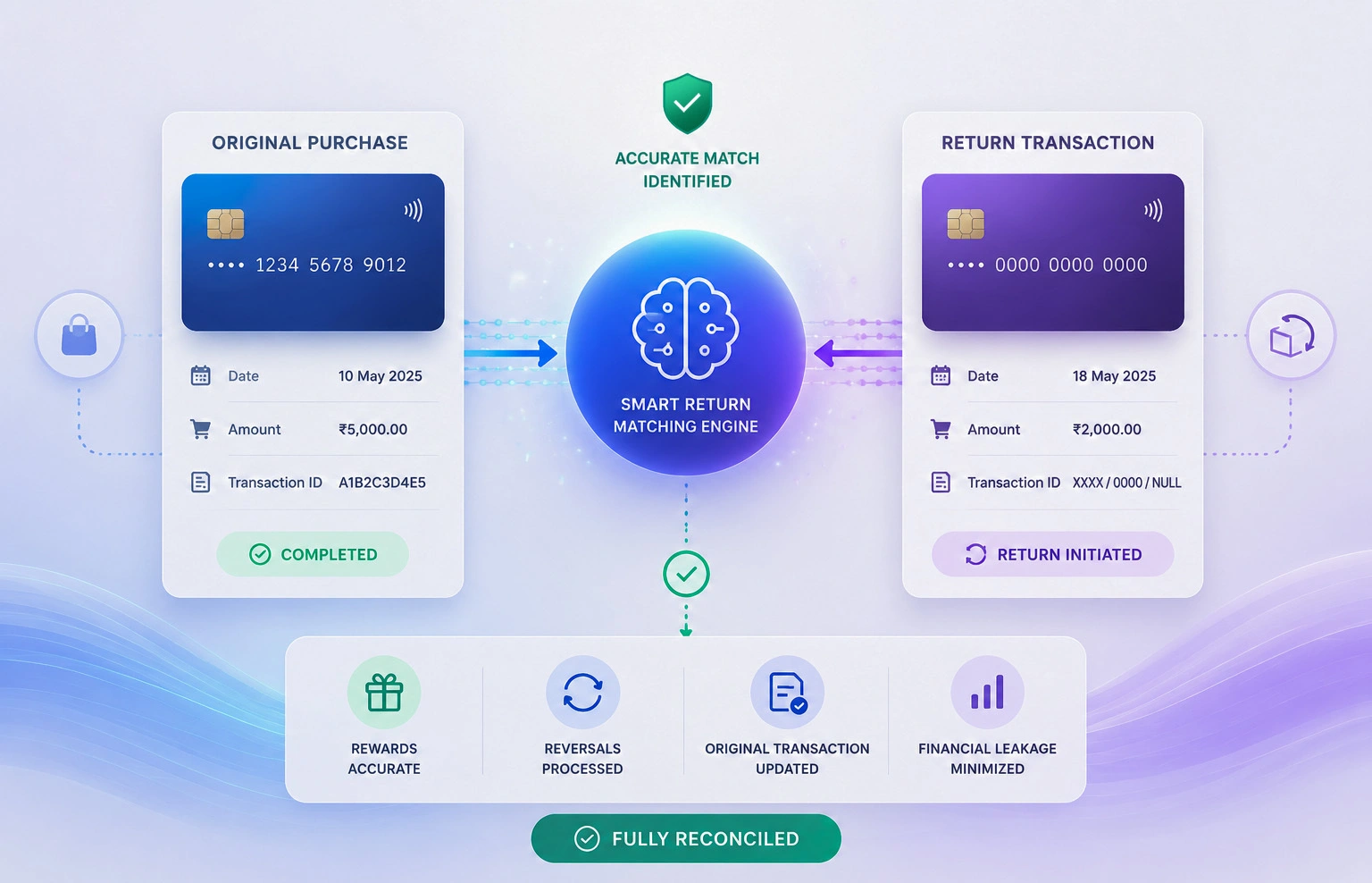
To address this challenge, we built a smart return matching engine designed to automatically identify and link every return to its corresponding original transaction.
The solution handles both full and partial returns, using transaction data and matching logic to determine the correct relationship even when standard identifiers are missing, inconsistent, or unreliable.
Once a match is established, the appropriate downstream action can be triggered automatically — reducing the need for manual investigation while ensuring that rewards, reversals, and transaction states remain accurate.
From Manual Investigation to Automated Accuracy
By introducing automated return matching, we were able to significantly improve the overall reconciliation process.
- • Unmatched returns were reduced
- • Transaction traceability improved
- • Potential financial leakage was minimized
More importantly, the solution provides a clearer view of the complete transaction lifecycle — from the original purchase through return, matching, and final reconciliation.
Small Change, Meaningful Business Impact
What appears to be a simple transaction-matching problem can have a much larger impact when multiplied across thousands or millions of card transactions.
By intelligently connecting returns with their original purchases, we transformed a potential source of silent revenue leakage into a controlled, traceable, and automated process.
The result is cleaner reconciliation, greater operational efficiency, stronger transaction accuracy, and better protection of the bottom line.