Escaping the Bottleneck: Scaling Selenium Grid
As automation test suites grow, sequential execution can become a significant bottleneck. For example, executing 100 tests that take approximately two minutes each can result in more than three hours of execution time. Testing across multiple browsers and operating systems further increases the execution time and infrastructure requirements.
Test Execution Bottleneck Breakdown
Comparison of sequential suite run vs distributed parallel execution:
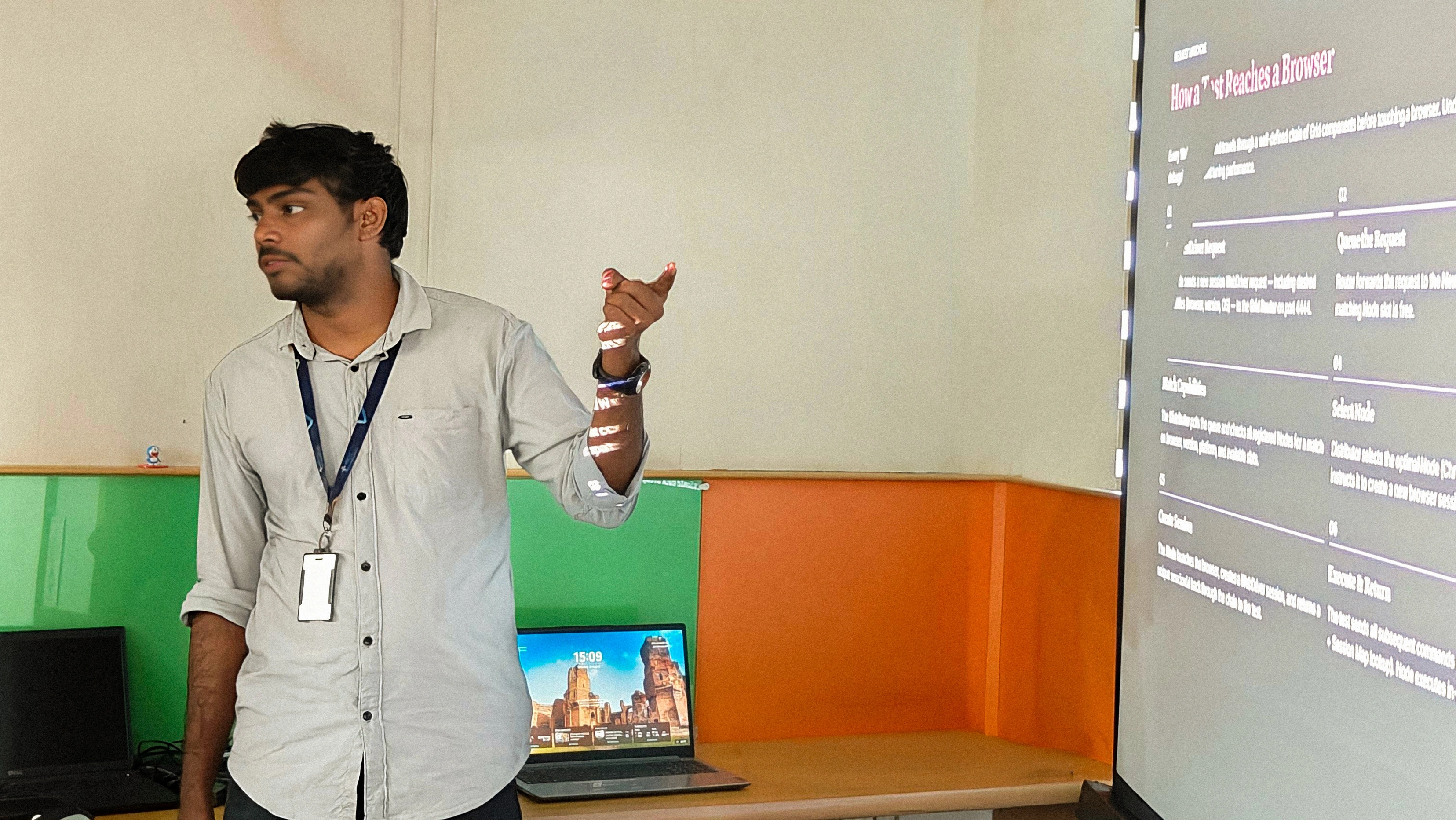
The session introduced Selenium Grid 4 as a solution for distributing automated test execution across multiple machines. The discussion began with the limitations of running multiple parallel threads on a single machine, where CPU and RAM become the primary constraints.
The session demonstrated how Selenium Grid enables WebDriver requests to be distributed across multiple independent Nodes through a centralized Grid architecture. A key part of the migration involved replacing local ChromeDriver instances with RemoteWebDriver, allowing test sessions to be executed on remote machines.
Thread Safety & Session Isolation
Thread safety was highlighted as an essential requirement for parallel execution. The session demonstrated the use of the ThreadLocal WebDriver pattern with TestNG to ensure that every parallel test thread receives its own isolated browser session and avoids conflicts or race conditions.
The session also covered infrastructure sizing and resource planning. For example, if a Chrome session consumes approximately 200 MB of memory, an 8 GB machine could theoretically support around 40 sessions based purely on memory availability. In practice, CPU usage, operating-system overhead, browser behavior, and application workload must also be considered before determining the safe concurrency limit.
Infrastructure Capacity Matrix
Overall, the session demonstrated that effective Selenium scaling is not simply about adding more hardware to a single machine. Selenium Grid enables horizontal scaling by distributing browser sessions across multiple nodes, providing a more flexible and scalable approach to large-scale automated test execution.
— Mohammed Salman