The "USB-C Port for AI": My Journey with the Model Context Protocol (MCP)
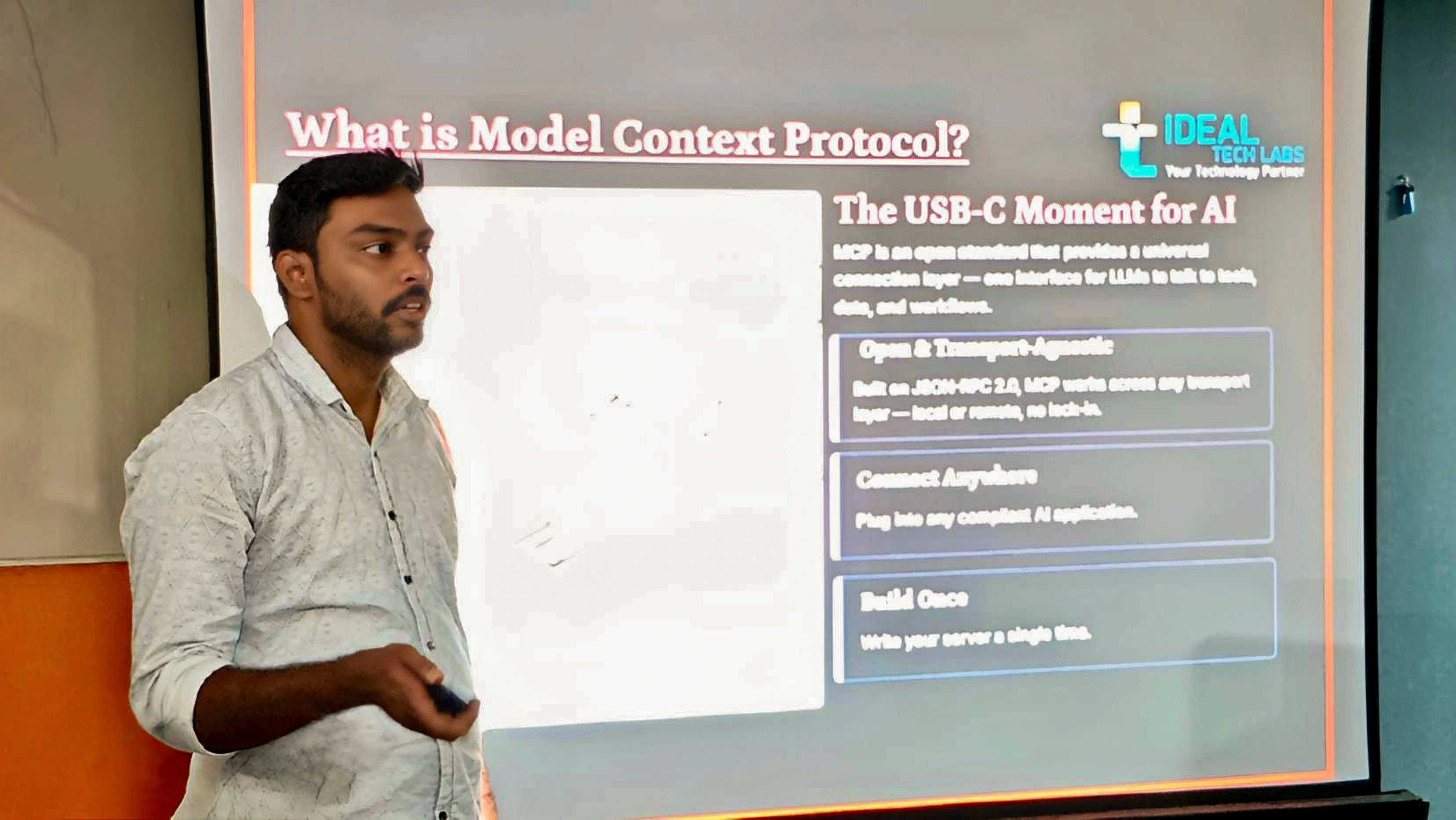
Building AI agents is exciting, but connecting them to enterprise data and external tools can quickly become a major challenge. Traditional approaches often require custom integrations for every new tool or database, resulting in fragile point-to-point connections that are difficult to maintain and scale.
The session introduced the Model Context Protocol (MCP), an open-source standard created by Anthropic in November 2024 that acts as a universal “USB-C port for AI.” The session explained MCP’s three-layer architecture: a Host that runs the AI agent, a Client that manages communication and negotiation, and a Server that securely exposes tools and capabilities.
Key MCP Technical Highlights
Demonstrated capabilities and architecture breakdown from the session:
As part of the practical demonstration, a production-grade MongoDB Intelligence MCP was developed from scratch. The project highlighted the importance of providing AI agents with specialized tools instead of relying solely on generic database query access. By exposing 14 distinct tools, the MCP demonstrated how an AI system can evolve from a simple database interface into an autonomous data analysis assistant.
The demonstration also covered capabilities such as automated schema discovery, which was completed in approximately 1.5 seconds, as well as autonomous anomaly detection. Advanced MCP sampling concepts were also discussed, demonstrating how sensitive information such as API keys can remain securely on the client side.
Overall, the session demonstrated how MCP can bridge the gap between static AI models and dynamic, real-world enterprise data. It highlighted the potential of standardized, secure integrations to simplify the development of scalable AI agents and multi-agent systems.
— Mohammed Salman