AI at Work: Turning Artificial Intelligence into a Secure Productivity Partner
Artificial Intelligence is rapidly changing the way we work. What began as rule-based systems has evolved into Generative AI, multimodal AI, and now Agentic AI—systems capable of supporting increasingly complex tasks and workflows. The real opportunity for organizations is not simply adopting AI, but learning how to use it effectively, responsibly, and securely.
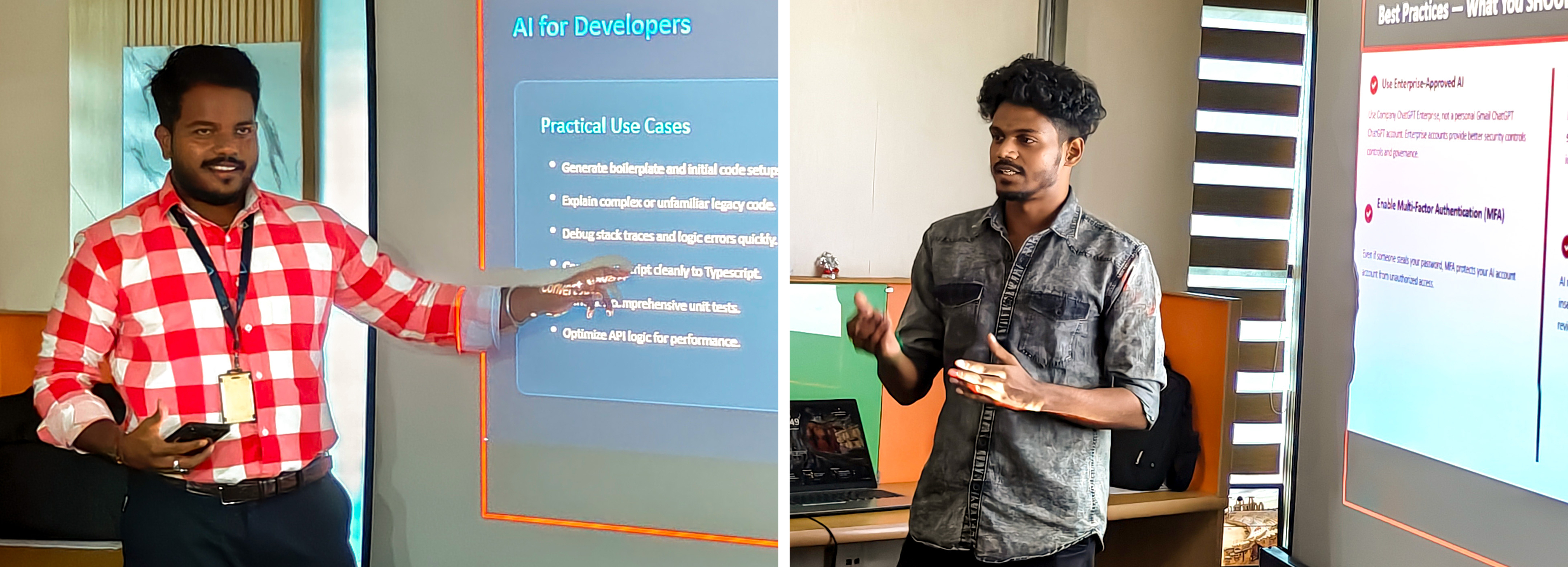
Today, AI can become a practical productivity partner across almost every technical and business workflow. Developers can use it to generate boilerplate code, understand legacy applications, troubleshoot errors, convert JavaScript to TypeScript, create unit tests, and optimize API logic. DevOps and system engineers can use AI to create Nginx configurations, Dockerfiles, PowerShell scripts, and troubleshoot complex infrastructure issues. IT teams can accelerate ticket resolution, hardware diagnosis, asset reporting, and professional communication.
AI is equally valuable for documentation. Installation guides, user manuals, release notes, SOPs, and meeting minutes can be generated from rough notes and bullet points, allowing employees to spend less time writing from scratch and more time reviewing, refining, and ensuring accuracy.
However, getting good results from AI depends heavily on how we communicate with it. Generic prompts often produce generic answers. Providing context, specifying the expected output, and clearly defining constraints can produce significantly more useful results. In other words, better prompts lead to better outcomes.
Productivity Impact Benchmarks
The productivity impact can be substantial. Examples presented in the session demonstrate significant time savings:
Yet AI adoption must go hand in hand with security. Employees should never paste passwords, API keys, AWS secrets, SSH keys, certificates, or tokens into AI tools. Customer data, production databases, confidential documents, and proprietary source code must also remain protected unless explicitly approved. Organizations should use approved enterprise AI platforms, enable MFA, anonymize sensitive information, review AI-generated code, verify outputs, and immediately report accidental data exposure.
Most importantly, AI should assist—not replace—human expertise and judgment. Leadership, emotional intelligence, creativity, ethics, strategic thinking, relationship building, negotiation, and innovation remain critical human capabilities.
The Future Formula
Human Intelligence + AI Intelligence = Augmented Intelligence
AI is most powerful when it solves real workplace bottlenecks while humans provide context, judgment, accountability, and final validation. By combining AI-powered productivity with responsible security practices and uniquely human skills, organizations can build a faster, smarter, and more capable workforce.
— Rishi & Vigneswaran